Wednesday, 12 December 2007

Christmas Eve treat for Windsor clubbers


Okay, so it's not a Wednesday, but WOW! Wicked on Wednesday season at Chicago Rock Cafe Windsor ends the year with news that hearthrob PC Will Fletcher from The Bill, is to see his Christmas Day in at the popular nightclubs and bar.

Well, actually it is actor Gary Lucy, a firm favourite with fans who have followed his TV career right from "Hollyoaks" through "Footballers' Wives" to his current success in ITV's hit series "The Bill".

He will be joining customers at Chicago's on Christmas Eve to help everyone get into the festive mood, complete with a disco through til 2am.

We hope to see you there!

Tuesday, 27 November 2007

Corporate Killing – the new law from April


The purpose of the Corporate Manslaughter and Corporate Homicide Act 2007 is quite straight forward and is intended to find corporate organisations guilty in respect of deaths caused by their negligence.


It removes the onerous requirement of the current law requiring proof of personal and individual guilt of manslaughter of one of the “controlling minds” of the company. This requirement had always made it notoriously difficult for medium to large sized organisations to be held properly accountable for deaths occurring in the course of their employment.


Its provisions will not come into force until the 6th April 2008 and operators of nightclubs need to reflect on its implications.

The new legislation poses no additional regulatory burdens upon organisations. It simply changes the way in which blame is apportioned and broadens the categories of those who may be prosecuted. Under the old common law offence of manslaughter only individuals and corporate bodies could be prosecuted. The new offence extends to partnerships, trade unions, employers bodies, police forces and government bodies but that is of academic interest to operators.

The new offence will be committed by an organisation “if the way in which its activities are managed or organised a) causes a persons death, and b) amounts to a gross breach of a relevant duty of care owed by the organisation to the deceased”.

Operators need to realise that the organisation will in fact mean the “Senior Management” of that business, although the legislation is a bit vague on what exactly this expression will mean. However the new legislation will clearly not apply to deaths which are caused by the negligence of co-workers, for example


Of particular interest is the fact that the legislation does not require proof that any individual is guilty of an offence (as was the case under the old law) but simply allows the tallying up of a series of management errors which demonstrate that an organisation was criminally negligent.

The test will be whether the conduct alleged is a gross breach of any civil duty of care i.e. that the breach falls far below what can reasonably be expected of the organisation in these circumstances.

The possibility of an unlimited fine or conviction is unattractive enough. In addition, the court may make a “publicity order” requiring the convicted company to publish details of the offence and the penalties. Whether naming and shaming will help anyone remains to be seen!

The new legislation does not alter the position with regard to individual liability for Directors or anyone else in the organisation. They may still be prosecuted as before if gross negligence can be established in the conduct of their individual roles.

Operators will need to decide what steps – if any – they need to take to protect themselves from what is perceived by many as a legislative change making it easier to secure convictions against the corporate entity.


This article is not intended to be a definitive guide to the law. We thought that it might be helpful to remind us operators that it would be a good time to reflect on our staff training (of existing as well as new employees), our internal procedures and our insurance policies.


Monday, 19 November 2007

The new licensing legislation in England and Wales


We have received several enquiries from students who asked for help in understanding the new licensing legislation in England and Wales.


Our simple explanation is as follows:

A Personal Licence is required by an individual in order to sell or authorise the sale of alcohol. This is granted to the individual (not to the business) and therefore ‘travels’ with them if they move on. The Personal Licence relates only to the supply of alcohol under a Premises Licence. It is valid for 10 years and can be renewed for further periods of 10 years.

A Premises Licence is compulsory for licensable activities (i.e. the sale of alcohol) to be undertaken by an outlet. This may be held by an individual (e.g. the owner or lessee) or a company (e.g. Pub Management Company).

The Designated Premises Supervisor (DPS) is a person nominated to be in day-to-day control of the premises and the single point of accountability for any problems which may occur on the premises. This is a key change to the Licensing Act, as every outlet must have a single DPS who is also the holder of a Personal License. Any premises selling alcohol without a DPS will be in breach of licensing law.

Licensing Objectives:

  • The prevention of crime and disorder

  • Public safety

  • The prevention of public nuisance

  • The protection of children from harm


We hope this is helpful as an introductory guide.

Photo: courtesy of WOW! Wicked on Wednesday (www.wickedonwednesday.com)

Sunday, 7 October 2007

Natalia - rising star to watch!


I had the pleasure to meet a terrific young performer, Natalia, and to see her perform before a packed house at The Academy in Basingstoke.
Natalia performed a range of songs from her forthcoming Album (due for release on Upper 11 records in February) which went down well with the mixed age-range audience. Her single is definitely one destined for the Top Ten or I will eat a whole box of Jaffa Cakes!
What was most impressive was her stage presence. She had the audience eating out of her hand!
By the way, no I haven't put on even more weight. Natalia is tiny! Honest!

Friday, 21 September 2007

New technology to control access to our venues


As we decorate our venues for Christmas, as discussed in my previous article, venue operators must also think about the wider management issues.

According to Home Office figures in February 2006, 6000 test-purchases took place in the run-up to Christmas resulting in 800 summons for serving under-age. A charge that carries up to £5000 fine, on the-spot-fines, 6 month imprisonment and the revocation of the DPS licence. Repeated offences could call the licence in for review.

The government, the media and numerous other authorities are constantly examining the relationship between alcohol (both underage and irresponsible consumption) and anti-social behaviour.

The British Beer & Pub Association (BBPA) has sent a letter to London MPs with the latest statistics from Camden and Westminster council, published as part of a consultation on revised licensing policies, which show a decrease in crime rates in the first year of the new Act. I may be cynical but I worry if this is just an industry smokescreen based upon some selective figures. I may be wrong but my perception isn’t this!

But it’s not just about crime on the street, under-age drinking or drink-driving, there are also issues about protecting staff and our property. Maybe, we need to think more about who we let into our premises in the first place and what technology is available to help us.

I came across a new product called clubscan VIS (Visual Identification System) - a complex piece of programming and hardware which is simply installed at the entrance to your venue which will verify and collect data from Customers ' personal ID such as Passports, Driver's Licences and Student IDs.

It processes all IDs placed through the scanner in seconds and uses OCR to extract all the data from the card and put it into a database. The information is then ready for you to analyse and use as you see fit.

I have seen a piece of kit like this in the US but it is the first UK product I have come across. If you are using it please drop me a review and I will include it on my site.

Website for clubscan is: http://www.idscan.co.uk/

Thursday, 20 September 2007

Sampling in bars and nightclubs


How often has a drinks manufacturer come in with a bottle of their latest product and asked us to stock it? They ask us to sample it and, if we like the concept, we order some in to try and sell them.

If we do, the sales representative will usually organise some point of sale (POS) material and maybe some free stock to help things get going.

Mind you, I have even known for none of this to happen. We order some and no POS turns up.

If the manufacturer or supplier has their wits about them they will organise a sampling team to come around but, because of the costs involved, this is happening less and less. More often, they will offer us some free stock so we can do it ourselves.

I like sampling. It gets the product before the customer and onto their lips but it also allows the sampling team to interact and quickly build up a rapport with my customer; this works especially well with outside teams coming in rather than using my own staff.

It is all about getting the customer to try and then buy - it is not about a free drink between rounds, so the campaign has to be carefully thought out. Some managers get difficult about sampling and say it takes sales away from the bar but that is not my experience if the sampling is carefully thought through. What it can do is to retain customers for a longer period than they originally planned!
The worst case scenario is the big multiples whose head office direct their venues to "must stock" new lines without any POS or promotion. It just appears on shelves and then the manufacturer wonders why there is no repeat order - it's because it hasn't sold! And that is because there was no promotion!

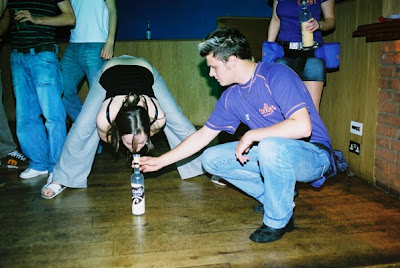
My advice? Use sampling and use it well. Play games like the Corky's team are doing in the photo above - make the experience fun, maybe give away some badges or tee-shirts. Get the DJ to join in the fun and hype it up. Whatever it takes to get the product off your shelves in a way in which customers enjoy the experience and come back to your venue for more!

Deposits on beer kegs on the horizon


Recently, I received a letter from my brewery telling me that they had seen their kegs used as bbq's and as rafts in charity boat races. They cost a lot of money so implored their customers to ensure their safe return.

Regional brewers are coming round to the idea of charging licensees deposits on kegs, under a proposed scheme that could start in 2008.

That is according to the British Beer & Pub Association’s (BBPA) brewing director David Long, who heads the BBPA-backed working party looking at the idea.

Plans to charge licensees deposits of up to £50 per container were raised last year in response to a spate of thefts. The BBPA has sent out questionnaires to brewers asking their views on details of the scheme. Last week, the working party made a presentation about keg deposits to council members of the Society of Independent Brewers (SIBA).

Smaller brewers had expressed concern about the costs of implementing and operating a deposit system.

My view is that this is yet another burden on small businesses. The breweries have detailed statistics on each customer's purchases so they know who has had what number of kegs and returned how many.

It would not be rocket science to charge those that have failed to return them rather than Breweries take money from the rest of us and hold it in their bank accounts until such time as they see fit to return it.


John Hicks